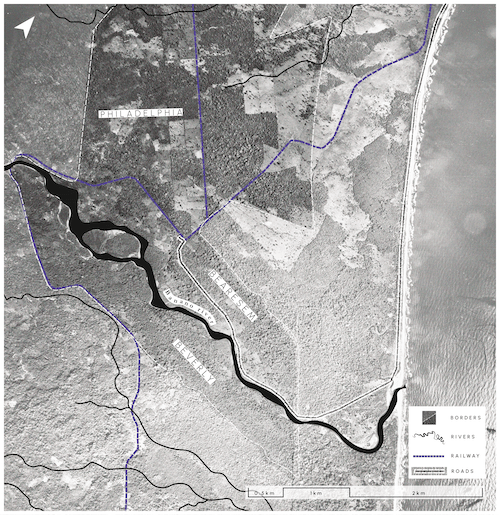
We work with a transregional and heterogeneous archive of drawings, blueprints, images, correspondence, work schedules, manifestos, field notes, and science reports. The diversity of materials allows us to grasp and spatialize histories of extraction, human suffering, disease, and contamination. Our archive contains both corporate and institutional gazes and thus lets us think of the often subordinate interrelationships between United Fruit’s (UFCo) actions and state governance. In the archive, we can see how the company meticulously, and perhaps proudly, documented its extractive practices, flooding experiments, and pesticide spraying trials. The handmade drawings of the banana farms made during the first banana boom (1870-1914) reflect the importance of land surveying for United Fruit’s activities. Behind their bucolic and almost nostalgic appearance, these plans conceal a history of environmental harm and epidemics. Farm blueprints of Coto 47 and Palmar Sur and Norte illustrate a different story (1940s-50s). While they show us how the company replicated the farm template when shifting its operations to Costa Rica’s Pacific coast, they also portray a techno-agricultural landscape composed of interconnected infrastructure layers that included fumigation paraphernalia.
 Contaminated Forms